The real thing
This is what you will be using
Not mock-ups: screenshots of the working application with a real case file loaded. They are in Spanish because the application is in Spanish.
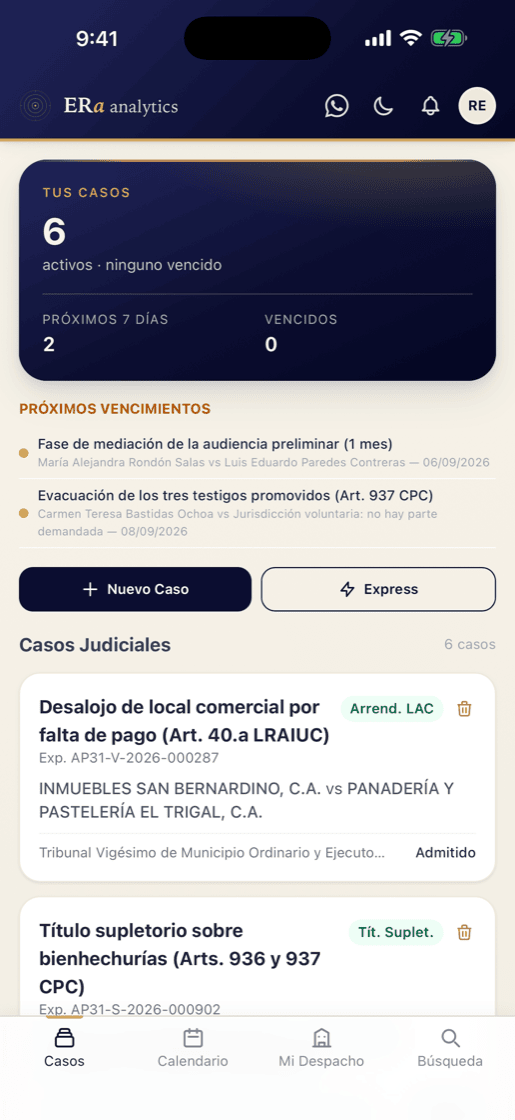
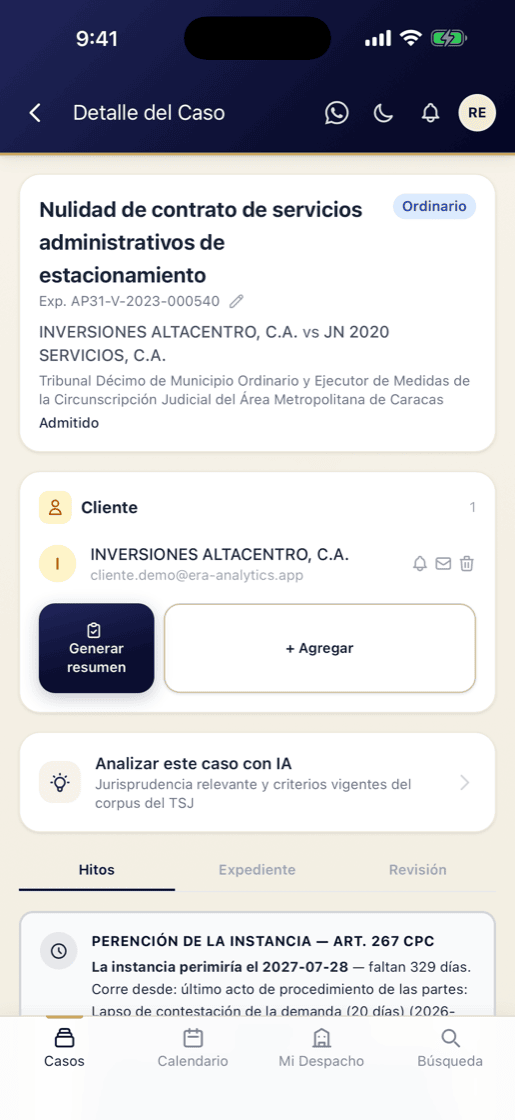
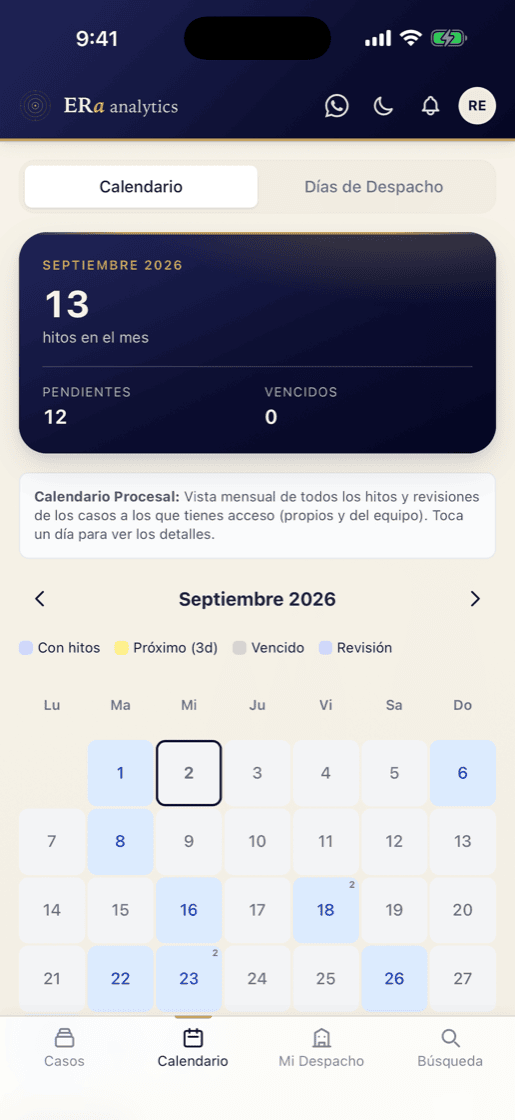
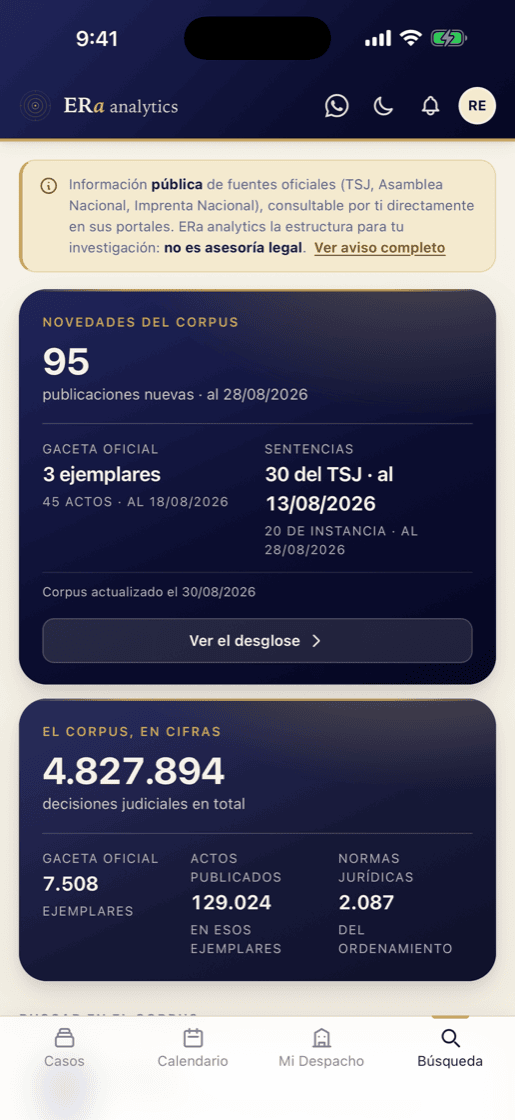
ERa analytics computes every deadline in your case across 17 Venezuelan procedures and models the full chain of appeals up to the Supreme Court. In the same application, you search the corpus: Supreme Court decisions, the Official Gazette and the statutes in force.
No credit card. Every feature included. The application interface is in Spanish.
Not mock-ups: screenshots of the working application with a real case file loaded. They are in Spanish because the application is in Spanish.
The two things a lawyer does every day are run their cases and study what has been decided before. Those lived in separate tools. Not here.
Cases, deadlines, clients and fees. The engine generates every procedural milestone against each court's business days, holidays and judicial recesses, and warns you before anything falls due.
The Venezuelan legal corpus, structured and queryable: what the Supreme Court held on a point, who held it, which statute governs it and whether it is still in force.
Each card opens a different search over the same base: Supreme Court decisions from 2000 to 2026, the Official Gazette and the statutes in force. Results come out structured — with their chamber, date, reporting justice and citation — and from any of them the full text opens.
Incorporated today: 18,831 Supreme Court decisions with 13,853 isolated holdings, 19,523 trial-court decisions from the regional archive, and 129,010 acts from 7,507 issues of the Official Gazette. The corpus is partial and still growing: something missing from it does not mean it does not exist.
Behind that sits our own archive of 4,838,448 judicial decisions (2000–2026), 99.6 % of them already indexed for full-text retrieval. Decisions move from the archive into the searchable corpus as our AI pipeline structures them, week after week.
What the Supreme Court held on a specific point, with the isolated holding of the decision that contains it.
The full judgment: chamber, docket, reporting justice, parties, disposition and complete text.
Laws, codes, decrees and regulations with their articles, their publishing gazette and their status.
Who reported which decision, in which chamber and with what outcome, across the decisions ingested.
How first-instance judges have ruled in the regional archive, by court and by subject matter.
Search by name or bar number: which cases an attorney appeared in, and before which court.
Individuals and companies exactly as they appear in the decision, with their procedural role.
A question in plain language; the answer cites the decisions from the corpus it relies on.
Everything the search engine shows is public information obtained from official or openly accessible sources — the Supreme Court of Justice, the National Assembly and the National Printing Office. You can consult those portals directly at any time. Artifizio Technology LLC does not own that information and does not redistribute it in bulk: it structures it and shows it to the user who asks for it, in the same way that user could look it up in the primary sources.
ERa analytics is a legal research tool. It does not constitute legal advice of any kind. The corpus is partial and under construction: always verify the text, the status and the exact citation in the official source before relying on it. Terms, § 9 bis (in Spanish).
The engine does not keep a diary: it models the procedure. It knows what follows each step, how long it lasts, and against which court's calendar it is counted.
Generates every procedural milestone in the case, respecting court business days, public holidays and judicial recesses.
All of your due dates in a monthly calendar, with the business days of each individual court.
Every ruling opens a different branch. You pick the outcome and the system materialises the milestones that follow: appeal, review, jurisdictional challenge, dismissal.
Appeal, cassation with its binding doctrine (Arts. 322, 323 and 325 CPC), constitutional review, standalone amparo and avocamiento.
If the court rules after its own deadline, the system inserts service of notice and suspends every period until both parties are on notice (Arts. 233, 251 and 14 CPC).
The 4 groups of Art. 346 CPC with their full decision tree, and automatic closing of the incident inside the main case.
Individual and corporate clients with their commercial registration, shareholders, board, documents and engagement proposals with a printable PDF.
Your firm's month-end: collections, reimbursable expenses and the resulting margin, with the converted equivalent.
22 permissions per team member: milestones, incidents, court files, portfolio, business days and sending summaries to the client.
The firm records each court's business days together. Every change is audited with the name of whoever made it.
An executive summary of the case — status, progress, next steps — as a PDF or by email, in one click.
Email alerts before every due date, with as many days of notice as you choose.
Upload every filing in the record — complaint, orders, judgments — and the system reads it: it recognises the text of every page and extracts facts, arguments and legal premises. What used to be hours of manual review resolves in seconds.
Sample query
«What has the Civil Cassation Chamber held about an appeal lapsing for defects in its formalisation?»
The answer cites the decisions from the corpus it relies on, with their number, date and chamber, so you can go and read the original.
Time limits, court business days, rulings, branching and references to the CPC, COPP, LOPT, LOPNNA and the special statutes. All of them available to every user.
Arts. 338-522 CPC, with the 4 groups of preliminary objections of Art. 346
Arts. 881-894 CPC, oral preliminary objections raised with the answer
Arts. 640-652 CPC, automatic conversion to ordinary proceedings if the debtor objects
LAI 1999 — modified summary track, Arts. 33-37
LAC 2014 — oral track, CPC Arts. 859-880
LAV 2011 — its own oral track, with the SUNAVI prerequisite
Judgment SC/TSJ 1070/2016 — non-contentious, not appealable
Separation in fact for over 5 years, filed jointly or by one spouse
Grounds of Art. 185 CC, each with its specific evidence
By mutual consent, with separation of property, Art. 173 CC
Each track implements the Supreme Court's 2014–2017 shift in doctrine (judgments 446/2014, 693/2015, 712/2014, 1070/2016, 136/2017 and 305/2017). Where there are minor children, the assistant checks that the court is a Children and Adolescents court (Art. 177 LOPNNA) and issues the ordinary track with its preliminary mediation and case-management hearings.
Arts. 123-186 LOPT, with preliminary hearing, mediation and oral trial
Appeal, employment cassation and review of legality before the Social Chamber
The 4 COPP stages, with the 8 branches open to the judge at the preliminary hearing
Arts. 372-373 COPP, arrest in flagrante with no intermediate stage
Arts. 391-409 COPP, without the public prosecutor, with mandatory conciliation
Arts. 523-555 CPC by type of order, with objections and third-party claims
For arrest in flagrante and habeas corpus the engine counts in continuous hours, around the clock — the 12, 36 and 48 hours of Art. 44 of the Constitution and the 24 of habeas corpus — without discounting holidays, because criminal duty courts do not close (Art. 156 LOPJ).
Docket, parties, court and which of the 17 modelled procedures applies. ERa generates the full course of the case.
Every filing you record recomputes the periods that follow. At a branching point you pick the outcome and the system materialises the stage that comes next.
Find the holding, the decision or the statute you need in the corpus, and take it into your brief with a citation you verified at the source.
This is not a generic tool with the labels translated. It models the procedures, the courts and the case law that actually govern here.
The system computes every period and warns you. No manual counting, no spreadsheets.
The holding you are looking for, with its judgment, chamber and date, ready to cite once you verify it at the source.
What used to be manual review of court files and blind searching resolves in seconds.
Phone, tablet or desktop, with your data synchronised in real time.
It works like a native app: its own icon on your home screen, full screen, and access without opening a browser.
You can also use it straight from the browser, with nothing to install.
Free for a limited time, with every feature included and no credit card. The application interface is in Spanish, the working language of Venezuelan legal practice.
Create a free account