The product, screen by screen
ERa analytics is a working application, not a landing page. It is live in production at era-analytics.app, it is open to the public, and anyone can open an account and use it right now. The screenshots below are the real interface — they are the same captures submitted to the App Store, taken on a live account with a real case file loaded into it.
The interface is in Spanish. The product serves Venezuelan lawyers, and translating it would help nobody who uses it. This page is in English because the people who need to verify that the product exists mostly do not read Spanish. The captions explain what each screen does.
Getting in
Create a free account. No credit card, no invitation code, no waiting list and no sales call. The account is active the moment you confirm your email address, with every feature enabled.
Create a free accountOr sign in to the shared demo account, with no sign-up at all. It is loaded with three cases, their computed procedural timelines, a court calendar of sitting days and a client file, and it reaches the same corpus as any other account.
| Sign in at | era-analytics.app/calendario |
|---|---|
visitante@era-analytics.app | |
| Password | ERaDemo2026 |
Everyone shares this account and everything in it is fictional demonstration data — no real case, client or person. Please do not put anything of your own into it. If you want your own workspace, create the free account above.
Cases and deadlines
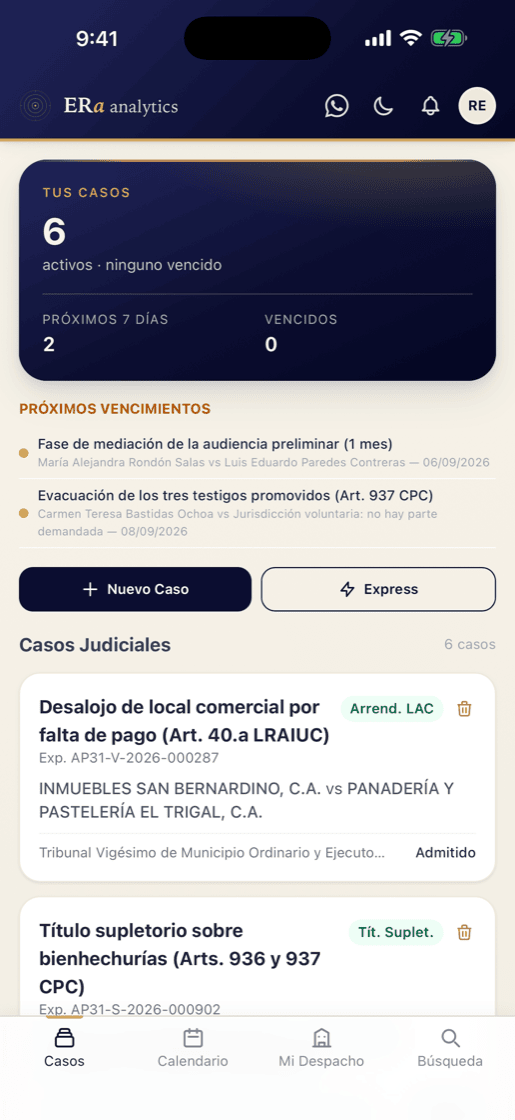
Every case, and what is about to fall due
Each case carries its procedure type, its docket number, the parties, the court that hears it and its procedural status. The header at the top is the one thing a litigator checks every morning: how many deadlines fall inside the next seven days, and whether anything has already expired.
The two entries under Próximos vencimientos are computed, not typed in: the application derived them from the procedural stage each case is in.
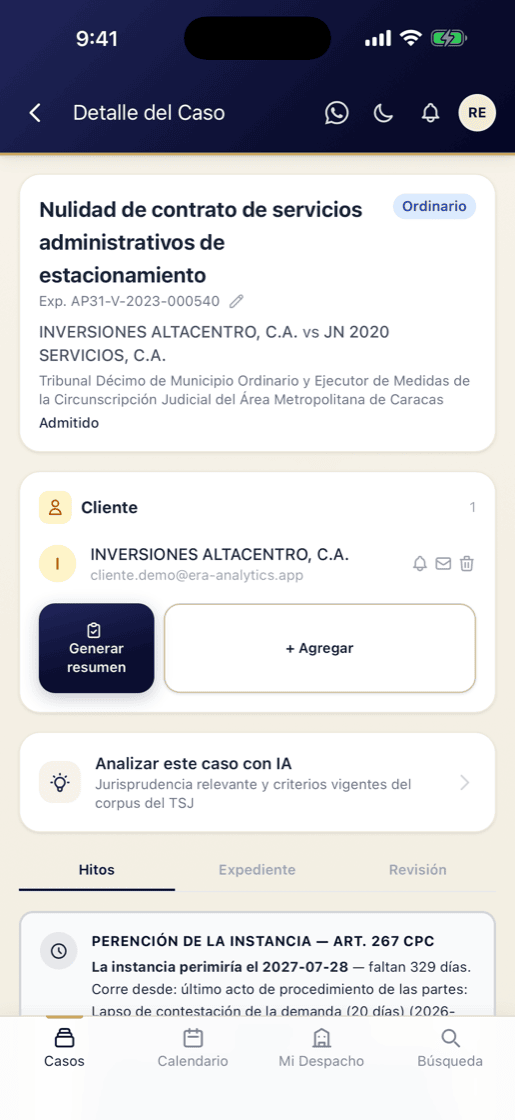
One case, and the computation behind it
This is the half of the product that had no tool in Venezuela. From the procedure type and the acts already recorded, the engine builds the whole chain of deadlines: which stage is running, under which articles, when it opened and when it closes — counted against the business days of the specific court, with its holidays and judicial recesses.
The panel at the bottom of the capture is the lapsing of the action under Article 267 of the Code of Civil Procedure: the application states the date, the days remaining, and the act it is counting from — because the rule counts from the last act of the parties, and a judge's decision in between does not reset it.
Analizar este caso con IA is where the two halves meet: it takes the case file and searches the corpus for the Supreme Court precedent that governs it, citing each decision. That is the feature that runs on Gemini models on Vertex AI.
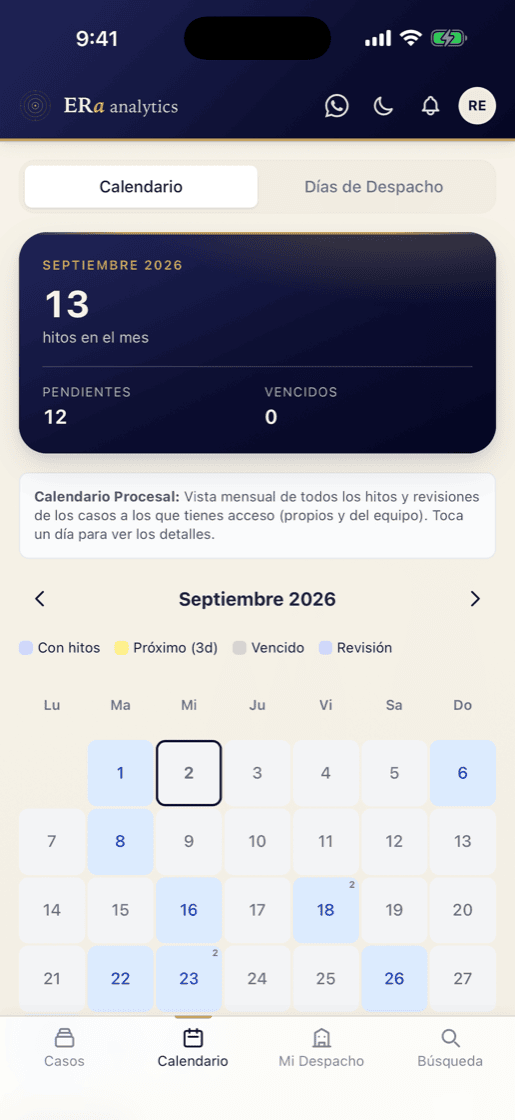
Every milestone of every case, on one month
The same computation, seen from the calendar instead of from the case: every milestone the lawyer has access to — their own and their team's — on a month view, colour-coded by how close it is.
The second tab, Días de Despacho, is the raw material: the days each court actually sat. Deadlines in Venezuelan procedure do not run on calendar days, and a court that did not sit does not consume one.
The corpus
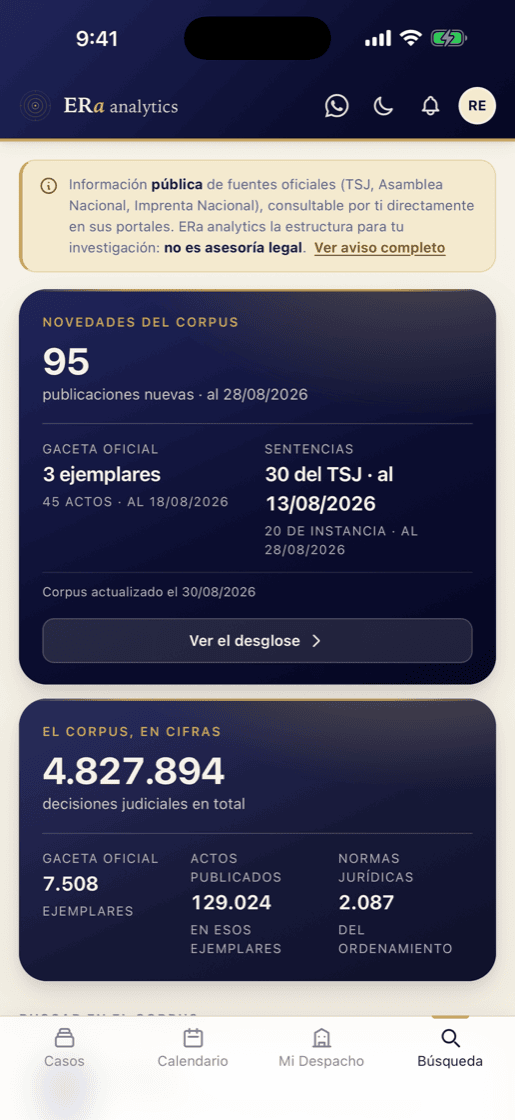
Venezuelan law, structured and queryable
The other half of the application. The judicial archive of Venezuela is public and enormous, and none of it is queryable as data: the Supreme Court publishes through search portals of limited scope, and the Official Gazette is not structured at all.
Eight ways into the same base — by legal holding, by decision, by statute, by justice, by trial judge, by counsel, by party, and a natural language question whose answer cites the decisions it rests on. The top card is what came in this week: the corpus grows every week, and the application says so rather than pretending to be complete.
The figures on the card move as the pipeline processes the archive, so they are lower here than on the company page, which states today's numbers. Everything in it is public information from official sources — the Supreme Court of Justice, the National Assembly and the National Printing Office.
The practice
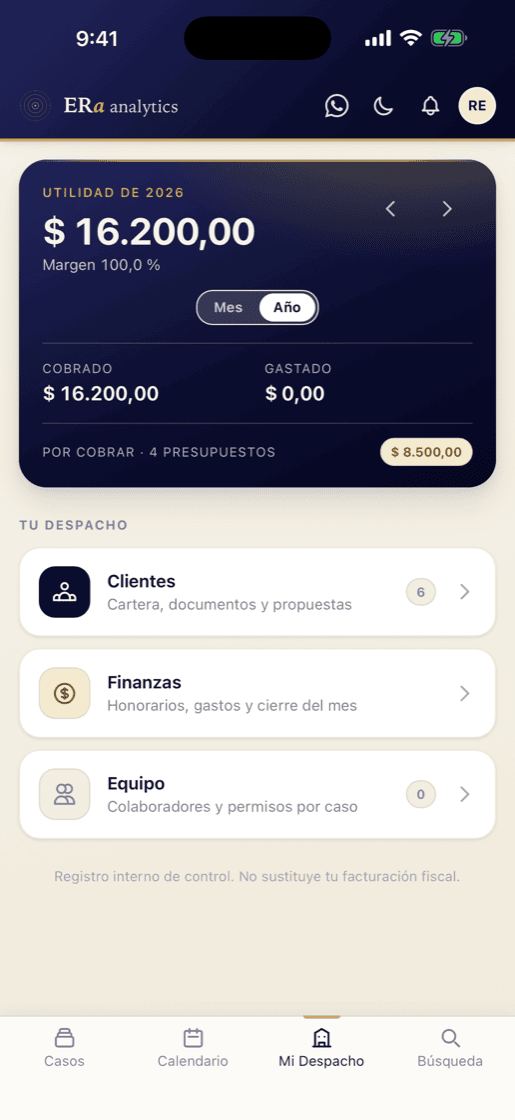
Clients, proposals, fees and team
A small practice does not run a separate system for this. Clients and their documents, proposals with their approval and their instalments, fees charged and expenses paid, by month and by year — and collaborators, with twenty-two distinct permissions granted per case.
The amounts in the capture are demonstration data on the account the screenshots were taken from. The disclaimer at the foot of the screen is in the product itself: this is internal control, not tax invoicing.
Where the product runs
ERa analytics is a progressive web application. It runs in any modern browser and installs on Android and iPhone straight from the browser, with no store needed — which is how it is being used today. Native builds of the same application are under review on the App Store and Google Play.
It runs on Cloudflare (Pages and Workers) and Google Cloud: Gemini models on Vertex AI perform optical character recognition on the court files users upload, structured extraction over each judicial decision, and the retrieval agent that answers questions citing the corpus.
ERa analytics is a legal research and practice tool. It does not constitute legal advice.
- Company — who builds this, with the registration details of the entity
- Support and FAQ (Spanish)
- Questions about the product: soporte@era-analytics.app
Last updated: 12 September 2026.